
Ontological Core and AI: Why Your Organization Must Consolidate Its Ontological Core with Ontologies and GraphRAG
Introduction: The Illusion of LLMs and the Real Challenge for Businesses
The generative artificial intelligence (GenAI) revolution is disrupting all industries. Every month, new models (GPT, LLaMA, Gemini…) promise productivity gains, smarter assistants, and faster automations.
However, AI alone will not save businesses. A large language model (LLM) is merely a compressed mirror of its training data. If your organization relies on scattered data, information silos, and poorly structured knowledge, AI will produce fragmented, inconsistent, and largely unusable responses.
The real challenge lies elsewhere: in building your Ontological Core – the ontological core of your business.
Compression and Structure: What LLMs Teach Organizations
A language model is primarily a meaning compression machine.
Example: LLaMA-7B condensed nearly 10 TB of text into 140 GB of numerical parameters. The performance of this compression relies on the latent structure of the data.
Applied to the business world:
- The more connected and structured your data is,
- The more compressible and usable it becomes,
- The more your organization gains in agility and resilience.
👉 In other words: AI needs a solid core, and your business does too.
Why Not Everything Is Semantic: The Great Misunderstanding
An LLM can read text, but it doesn’t know your business context.
Let’s take an example:
“Customer X canceled their subscription because the service was too complex.”
An LLM extracts linguistic meaning: “client” is linked to “canceled,” “subscription,” and “complex.”
But this is not yet semantic at the organizational level:
- Who is this customer in your CRM?
- Which product or service is affected?
- Which team is responsible?
- Is this a trend or an isolated case?
👉 Without a business ontology, your data remains isolated sentences. They do not reflect your identity or organizational logic.
Ontology and Data: The Backbone of Organizational Intelligence
An enterprise ontology is much more than a dictionary. It is a mapping of concepts and their relationships.
It defines:
- the key entities (customers, products, segments, needs, risks…),
- the relationships (a customer has a need, a product addresses a segment, a trend impacts a market…),
- the consistency rules that ensure a shared language.
With a robust ontology, your data becomes truly semantic. It aligns with your business functions, processes, and strategic objectives.
👉 This is the foundation of your Ontological Core.
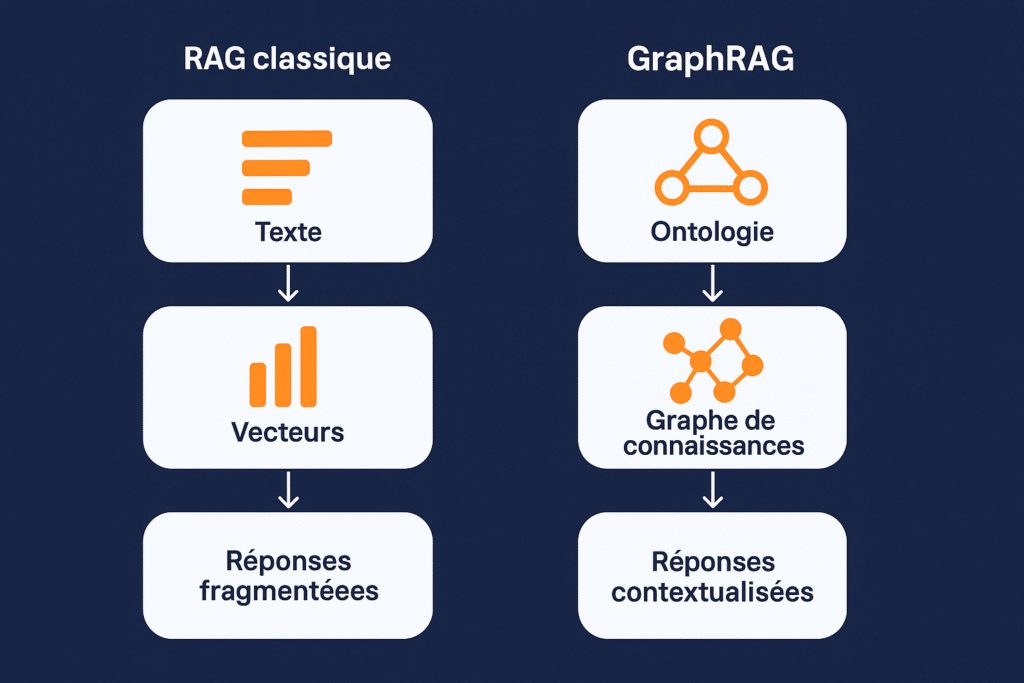
From Classic RAG to GraphRAG: Moving from Raw Text to Knowledge Graph
RAG (Retrieval-Augmented Generation) is currently the dominant technique for connecting LLMs to enterprise data. But it has limitations:
- Documents are stored as vectors,
- AI searches for the closest passages,
- The model produces a response by piecing together excerpts.
Problem: the result remains fragmented. No overall view. No business logic.
GraphRAG overcomes these limitations:
- Data is decomposed into entities and relationships.
- It is organized into a knowledge graph linked to the ontology.
- AI can navigate this conceptual network, following the links, to generate contextualized and reliable responses.
Example:
Question: “What emerging needs impact SMEs in electric mobility?”
- Classic RAG: returns 2–3 excerpts containing “electric mobility” and “SMEs.”
- GraphRAG: connects the needs expressed by SMEs, industry trends, market segments, and customer feedback, leading to a structured and actionable response.
InnovFast: The Platform that Transforms Your Data into an Ontological Core
This is exactly what InnovFast does:
- Proprietary Innovation Ontology: needs, markets, weak signals, personas, TRL/MRL, ROI…
- GraphRAG by project and by client: every internal and external data point linked to this conceptual framework.
- Intelligent Compression: transforming documentary chaos into a compact and actionable core.
With InnovFast:
- Your data becomes contextualized and traceable.
- AI speaks the language of your business, not generic jargon.
- You gain a strategic frontier difficult for competitors to copy.
Case Study: From Chaos to a Solid Core with InnovFast
A fast-growing industrial company wanted to launch a product in a saturated market.
Traditionally, the process would have taken 6 to 12 months.
With InnovFast:
- Market study generated in 30 minutes.
- Customer needs modeled via synthetic personas.
- Concepts simulated and virtually tested → risk reduced by 50%.
Result: in less than a month, a validated concept ready for launch, with several hundred thousand euros saved.
Conclusion: The Future Belongs to Organizations with an Ontological Core
In an AI-driven world, your strategic frontiers are no longer defined solely by your products, but by the solidity of your Ontological Core.
The path is clear:
- Connect your data to avoid silos.
- Build a living ontology adapted to your business functions.
- Activate this core via GraphRAG and InnovFast to transform your data into strategic decisions.
👉 The real battle will not be between models, but between companies with or without a solid core.


